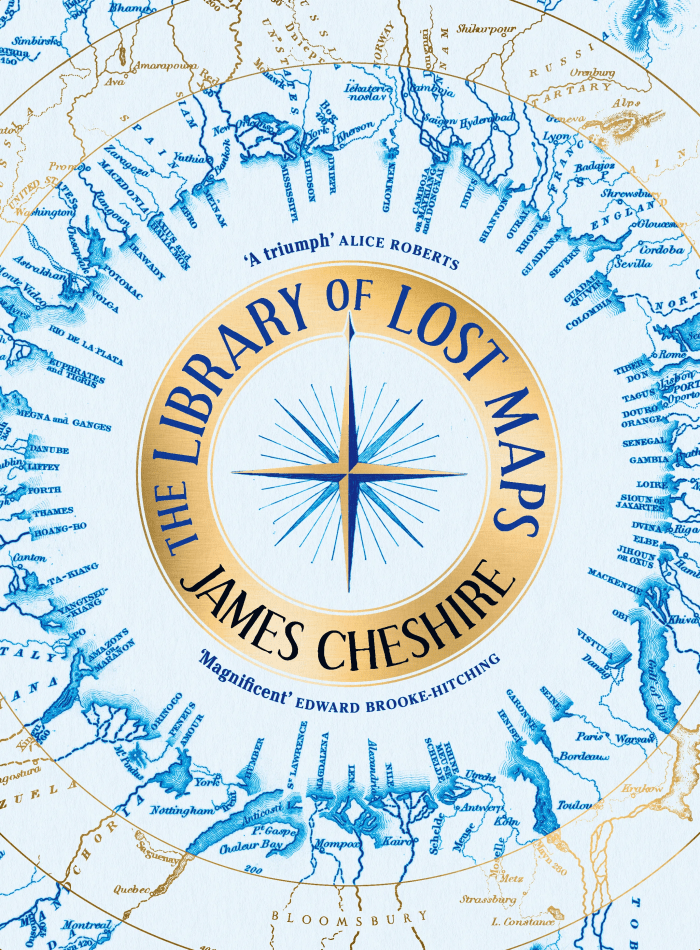
The Library of Lost Maps
James Cheshire
The remarkable story of an overlooked map archive that reveals how maps have helped inspire some of the greatest scientific discoveries, but also led to terrible atrocities.
At the heart of University College London, nestled in the centre of Bloomsbury, lies a long-forgotten map library packed with thousands of maps and atlases. After Professor James Cheshire stumbled upon it, he spent three years sifting through hundreds of dusty drawers to see what was there. He was stunned to uncover some of the most significant maps and atlases from the last two centuries – many of which had not seen the light of day for decades.
In The Library of Lost Maps we discover atlases for the masses that expanded nineteenth-century horizons and maps that were wielded by those in power to wage war and negotiate peace; charts that trace the icy peaks of the Himalayas and the deepest depths of the ocean; and pioneering maps produced to settle borders in central Europe or the wealth of those in inner-city London. Maps have played a vital role in shaping our scientific knowledge of the world, showing the impact of climate change and inspiring the theory of plate tectonics. They have also guided politicians, encouraging both beneficial reforms and horrific conquests, the consequences of which we continue to live with today.
Brimming with astonishing discoveries, The Library of Lost Maps reveals why cartography really matters and how map-making has helped transform our understanding of the world around us.
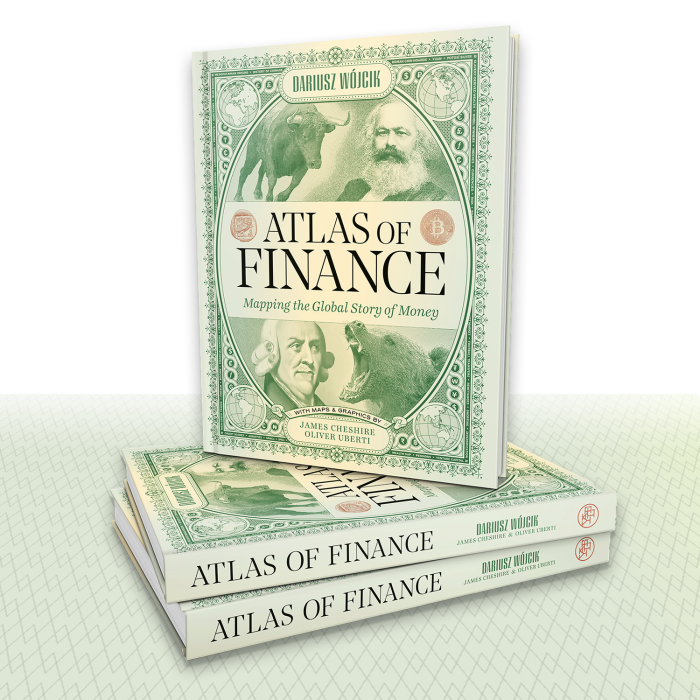
Atlas of Finance
Dariusz Wojcik, Panagiotis Iliopoulos, Stefanos Ioannou, Liam Keenan, Julien Migozzi, Timothy Monteath, Vladimir Pazitka, Morag Torrance and Michael Urban
Illustrated by James Cheshire and Oliver Uberti
A unique illustrated exploration of the development of finance that combines data from every part of the world and covers five thousand years of history.
From the emergence of money in the ancient world to today’s interconnected landscape of high-frequency trading and cryptocurrency, the story of finance has always taken place on an international stage. Finance is one of the most globalized and networked of human activities, and one of the most important social technologies ever invented.
This volume, the first visually based book dedicated to finance, uses graphics and maps to bring the complex and abstract world of finance down to earth, showing how geography is fundamental for understanding finance, and vice versa. It illuminates the people—including Adam Smith, Karl Marx, and John Maynard Keynes—who have shaped our thinking about global finance; brings to life the ways that place-specific histories, laws, regulations, and institutions influence finance; shows how finance relates to innovation, globalization, and environmental change; and details how finance plays a key part in drawing the landscape of uneven development, inequality, and instability.
The Atlas of Finance, with word and image, will change the way you view both your money and your world.
Atlas of the Invisible
James Cheshire and Oliver Uberti
Discover the hidden patterns in human society as you have never seen them before – through the world of data
In Atlas of the Invisible, award-winning geographer-designer team James Cheshire and Oliver Uberti redefine what an atlas can be. Transforming enormous data sets into rich maps and cutting-edge visualisations, they uncover truths about our past, reflect who we are today, and highlight what we face in the years ahead. With their joyfully inquisitive approach, Cheshire and Uberti explore happiness and anxiety levels around the globe; they trace the undersea cables and cell towers that connect us; they examine hidden scars of geopolitics; and illustrate how a warming planet affects everything from hurricanes to the hajj.
Years in the making, Atlas of the Invisible invites readers to marvel at the promise and peril of data, and to revel in the secrets and contours of a newly visible world.

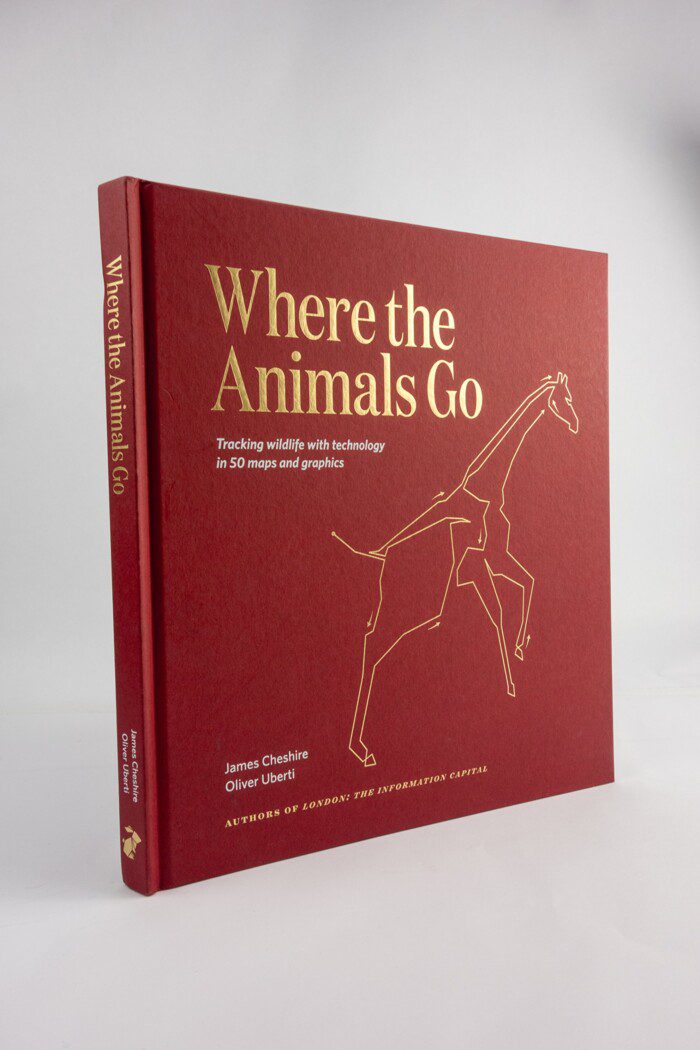
Where the Animals Go
James Cheshire and Oliver Uberti
For thousands of years, tracking animals meant following footprints. Now satellites, drones, camera traps, cellphone networks, and accelerometers reveal the natural world as never before. Where the Animals Go is the first book to offer a comprehensive, data-driven portrait of how creatures like ants, otters, owls, turtles, and sharks navigate the world.
Based on pioneering research by scientists at the forefront of the animal-tracking revolution, James Cheshire and Oliver Uberti’s stunning, four-color charts and maps tell fascinating stories of animal behavior. These astonishing infographics explain how warblers detect incoming storms using sonic vibrations, how baboons make decisions, and why storks prefer garbage dumps to wild forage; they follow pythons racing through the Everglades, a lovelorn wolf traversing the Alps, and humpback whales visiting undersea mountains.
Where the Animals Go is a triumph of technology, data science, and design, bringing broad perspective and intimate detail to our understanding of the animal kingdom.
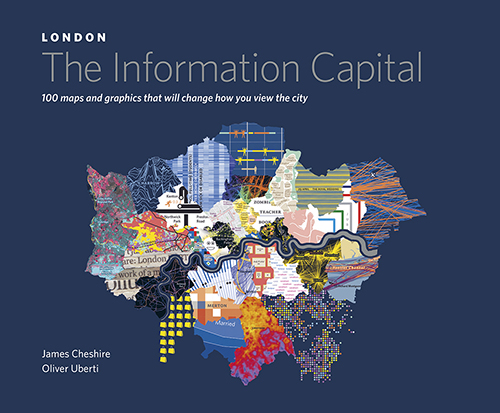
London: The Information Capital
James Cheshire and Oliver Uberti
In London: The Information Capital, Oliver and geographer James Cheshire joined forces to bring you a series of new maps and graphics charting life in a city like never before.
When do police helicopters catch criminals?
Which borough of London is the happiest?
Is ‘czesc’ becoming a more common greeting than ‘salaam’?
Oliver and James could tell you, but they’d rather show you. By combining millions of data points with stunning design, they investigate how flights stack over Heathrow, who lives longest, and where Londoners love to tweet. The result? One hundred portraits of an old city in a very new way.